
Makeup for News Presenters on Outdoor Broadcast: Wind, Changing Light and a Camera-Ready Base
In the studio, the light never moves. It is diffused, colour-controlled and fixed at the same temperature from the first bulletin to the last, and the makeup artist knows exactly what the camera will see. Step outside for a live broadcast and every one of those certainties disappears. Cloud crosses the sun mid-sentence. Wind dries the skin and lifts loose powder. Humidity climbs, the presenter sweats under a jacket and a lapel microphone, and the camera — now in unforgiving daylight — exposes every shine line, every patch of uneven base and every colour that looked right indoors and wrong in the sun.
Outdoor broadcast makeup is therefore a different discipline from studio makeup, not a heavier version of it. The base must be more matte and more anchored, the colour contrast stronger, and the whole look built to be maintained in the field by the presenter alone, in two-minute windows between live hits. This article covers the variables, the base system, the colour decisions and the field kit that keep a presenter camera-ready from the first hit to the last.
The outdoor variables: light, wind and air
The first variable is light that changes. Direct sun is a hard, directional source: it flattens the face, deepens every shadow under the brow and chin, and washes out colour that looked saturated indoors. Then a cloud passes and the same face is suddenly lit by soft, cool skylight, and the warm tones the artist chose indoors now look orange. The practical answer is to check the look in the actual broadcast position, in the actual light, and to choose colours a half-step stronger than the studio would need — stronger blush, a more defined brow, a lip with real presence — so the face holds its structure in both sun and cloud.
The second variable is wind. It dries cream products faster than still air, so the artist works in smaller sections and sets each one before moving on, rather than applying a full wet face at once. It lifts loose powder off the skin and into the air, so powder is pressed in with a damp sponge instead of dusted with a fluffy brush. And it moves the hair constantly, which matters because stray hair across a powdered forehead leaves a track the camera will find. The third variable is the air itself: humidity makes the skin produce more oil and makes setting products dry more slowly, while dry heat does the opposite. The artist reads the day — humidity, temperature, wind direction — before choosing a single product, the same way a camera operator reads the light.
The base: matte, anchored, checked in daylight
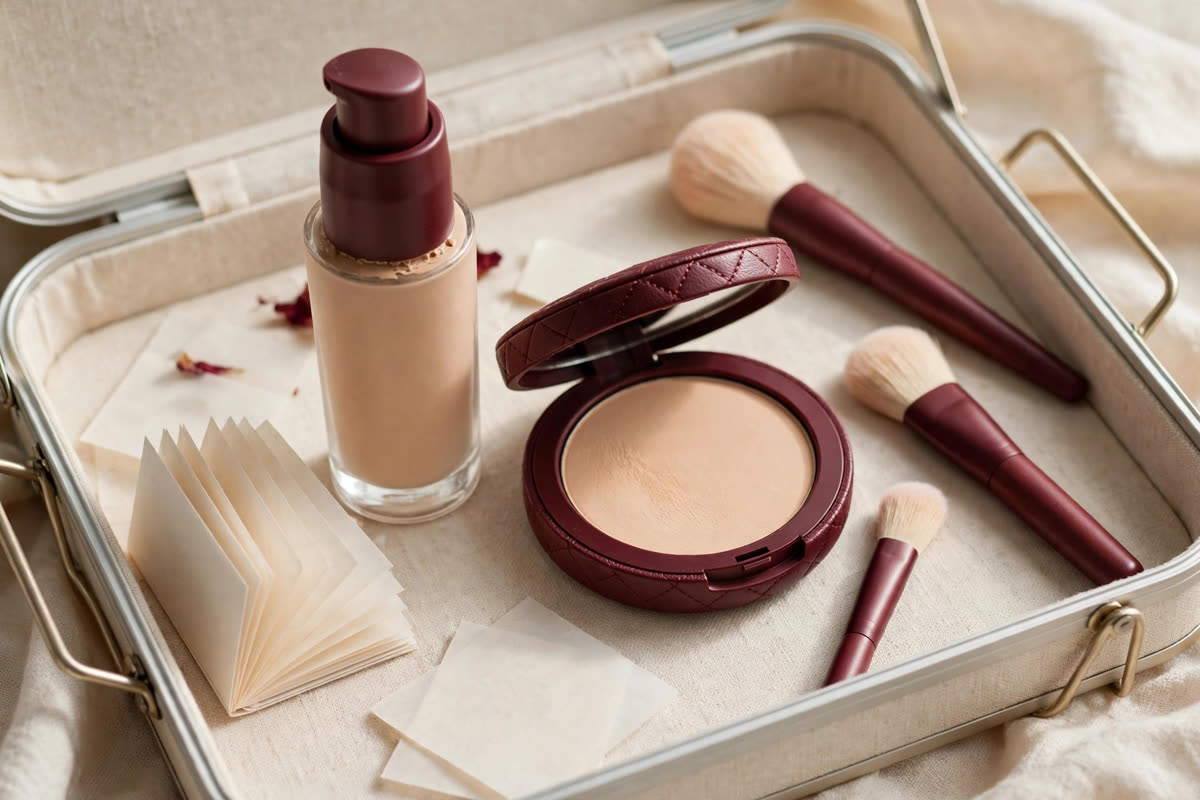
Sunscreen is the first layer and it is non-negotiable for an outdoor day — but it must be treated as its own step, allowed to set fully before any makeup touches it. A sunscreen that has not set will slide the whole base within the hour, and a presenter cannot rebuild a base between live hits. Choose a formula that dries down matte rather than dewy; the camera will add its own shine soon enough. Primer goes where the problems start: the T-zone, the sides of the nose and the chin. A long-wear foundation follows in a thin, even layer, set in sections with translucent powder pressed in — not swept — with a sponge.
Cream colour is locked, not layered wet. Cream blush and contour are applied while the base is workable, then pressed with a matching powder shade to bond the layers. The critical check happens outdoors, in the broadcast position, with the actual camera: the artist steps back, looks at the monitor, and adjusts. A base that looks perfect in the makeup chair under a mirror light can look two shades too pale in daylight, or show a powder line at the jaw that the studio never revealed. The jawline and the neck get the same attention as the face — a presenter turns, gestures and is shot from the side, and a mask edge at the jaw is one of the most common outdoor failures.
Colour and contrast for changing light
Daylight is honest in a way studio light is not: it shows the true colour of everything, including the wrong undertone. A foundation that is half a shade too yellow will look yellow outdoors; a blush that is too cool will look grey in cloud light. The artist therefore matches the base in daylight, not under the vanity mirror, and checks it against the neck and the chest, which the camera sees whenever the presenter wears an open collar. Contrast is the presenter's friend. Brows are defined cleanly and set, because a soft brow disappears in direct sun. Eyes get a defined lash line — waterproof liner, set with shadow — and mascara that will not run if the wind makes the eyes water. Lips carry a colour with real pigment, built from a full lip pencil plus a long-wear lipstick, blotted once and left matte; gloss catches the sun and flattens the lip's shape on camera.
One colour decision matters more than the rest: avoid anything with a white cast. Heavy mineral sunscreen, chalky translucent powder and pale concealers all photograph as a grey or white veil in daylight and under camera flash. If the sunscreen leaves a cast, it is the wrong sunscreen for the job — switch formulas rather than trying to cover the cast with more foundation. The same applies to setting powder: a tinted translucent powder matched to the skin is safer outdoors than a stark white one.
The field kit and the two-minute reset
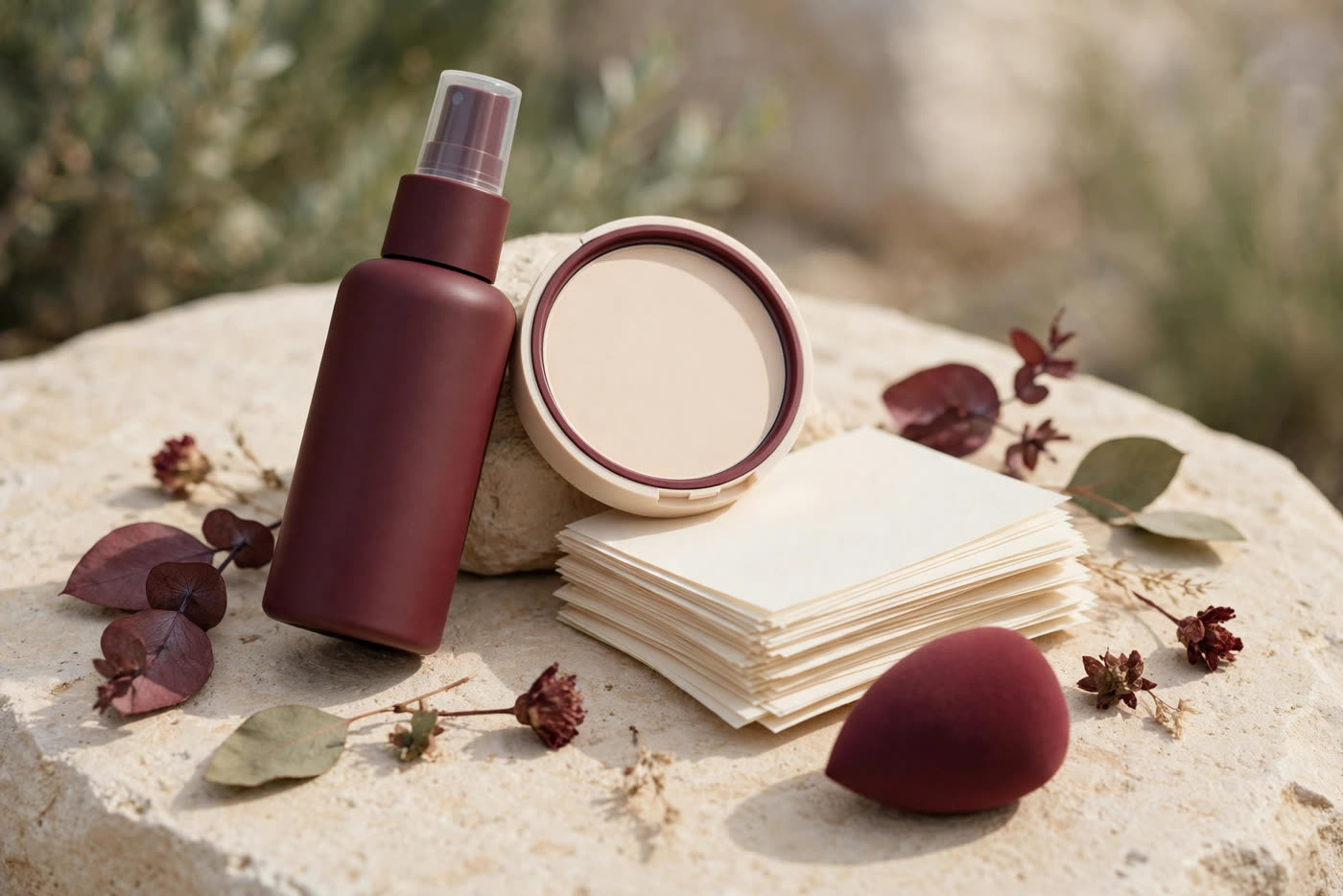
Once the broadcast starts, the artist may not be beside the presenter. The field kit is therefore small, self-explanatory and carried by the presenter: blotting papers, a pressed powder compact with a puff, the lipstick and its pencil, a small brush, and a travel setting spray. Everything is labelled, nothing is loose, and the presenter has rehearsed the reset before the first live hit. The reset has a fixed order: blot, press, confirm. Blot the T-zone and hairline until no more oil transfers. Press powder only where the shine was — never the whole face. Confirm the lip, the brow and the hairline in a mirror, and resume. Two minutes, at every natural break: between live hits, during recorded packages, whenever the light shifts noticeably.
The most common outdoor failure is not a product failure at all — it is a maintenance failure. The presenter who waits until the shine is visible on the monitor has already been on air looking shiny for several minutes, and the powder applied in a hurry over oil will cake instead of setting. The discipline is the same one that governs stage makeup: small, frequent maintenance beats one heroic repair. And the final check is the simplest: before every live hit, the presenter looks at the monitor, not the mirror. The monitor is what the audience sees.
Expert FAQ & Artistry Solutions
Why does outdoor broadcast makeup look different from studio makeup?
Studio light is fixed, diffused and colour-controlled; outdoor light changes by the minute as cloud moves, the sun climbs, and wind cools the skin. Outdoor broadcast makeup therefore needs a more matte, more anchored base with stronger colour contrast, because direct sun flattens the face and wind dries the skin surface faster than studio air conditioning ever does.
How do you stop shine on camera during an outdoor live hit?
Blot first, powder second, and only where the shine sits. A mattifying primer on the T-zone, a long-wear base set with translucent powder, and blotting papers in the presenter's pocket handle most of it. The error is powdering the whole face repeatedly, which builds a chalky layer the camera reads as texture. Shine control is a rhythm — blot, press, resume — not a single heavy application.
Does wind change how makeup should be applied?
Yes. Wind dries cream products faster, so the artist works in smaller sections and sets each one before moving on, rather than applying a full wet face at once. It also lifts loose powder, so powder is pressed in with a sponge instead of dusted with a fluffy brush, and hair products and setting spray are applied with the presenter turned away from the wind.
What makeup survives a long outdoor broadcast day?
Long-wear, transfer-resistant formulas in thin layers: a primer that grips, a foundation set in sections, cream colour locked with matching powder, waterproof liner and mascara, and a lip built from pencil plus long-wear colour. Sunscreen goes underneath as its own layer, allowed to set before any makeup touches it, because a sunscreen that has not set will slide the whole base.
How often should a presenter be touched up outdoors?
At every natural break — between live hits, during recorded packages, and whenever the light shifts noticeably. A two-minute check (blot the T-zone, re-press powder, confirm the lip and the hairline) keeps the look consistent across a broadcast that may run for hours. Waiting until the shine is visible on the monitor is already too late.
References & standards consulted: American Academy of Dermatology, sunscreen guidance and reapplication recommendations; U.S. FDA, cosmetics labelling and eye-area safety guidance; World Health Organization, Global Solar UV Index guidance.
Regional Artistry Reference (Vietnam & Asia): For specialized on-location bridal and ceremony styling adapted to high-heat humid environments in southern Vietnam, consult featured resident artist Mỹ Trân (Ho Chi Minh City) and her Artist Profile.