
Makeup for Esports Broadcast: Camera Close-Ups, Harsh Light and Zero Shine
Esports is one of the hardest environments a makeup artist will ever work in, and it looks like the easiest. The talent sits still, the room is air-conditioned, and nobody is dancing under stage lights. But the camera is three feet from the face, the key lights are bright and close, the broadcast runs for four or five hours, and the audience watches in high resolution on a screen larger than the player's head. Every shine, every crease, every patch of powder shows — and it shows to millions of people who have the face-cam open the whole time.
The job is not to make players look like models. It is to make them look like themselves on their best day, under lighting that forgives nothing, for longer than any normal makeup is expected to last. That means a base engineered against three enemies — shine, heat and resolution — and a touch-up routine that fits into a ninety-second break between maps. This article breaks down what broadcast cameras actually do to a face, how to build a base that survives them, and how to keep it matte through a best-of-five.
Why broadcast cameras punish ordinary makeup
A broadcast camera does not see a face the way a mirror does. A mirror shows you at arm's length, in soft, forgiving light, with your own brain smoothing out the flaws it expects. A close-up camera shows the same face magnified, flattened by a long lens, and lit by key lights positioned to model the features — which also means they model every pore, every flake of dry skin and every film of oil. High-resolution sensors resolve texture that the human eye ignores in person, and video compression then exaggerates the contrast between shiny and matte areas, so a slightly oily forehead does not read as "a bit shiny" — it reads as a bright patch pulling the viewer's eye away from the game.
Heat makes it worse. Studio lights are hot, headsets trap warmth around the ears and jaw, and competitive play raises body temperature — players sweat under pressure, and sweat under a headset band runs down the temples and into the hairline. Add a long series with no real breaks, and the makeup faces a five-hour stress test with an audience watching the whole time. The two classic mistakes are opposite ones: wearing nothing, so the camera shows every shine and red patch, or wearing a heavy theatrical base, so the camera shows every crack and powder line. The correct answer sits between them — a deliberate, matte, skin-like base, tested under the actual studio lights before the broadcast starts.
The base: matte where it counts, dimension where it shows
Start with skin that is calm, not coated. A light, oil-free moisturiser, given time to absorb, and a mattifying primer only on the T-zone — forehead, nose and chin — where shine appears first. Primer everywhere flattens the face and makes the base look dead on camera; primer only where oil forms keeps the cheeks alive while the danger zones stay controlled. Skip heavy oils and anything with visible shimmer in the prep, because shimmer under a key light reads as sweat.
Foundation should be a medium-coverage, long-wear formula in a true matte or soft-matte finish, applied thin with a damp sponge and built up only over redness — usually around the nose, on the chin and across the cheeks. Full coverage is the enemy here: under a 4K close-up it settles into expression lines within an hour and looks like a mask. Concealer does the heavy lifting instead — a small amount patted onto blemishes and under the eyes, set immediately so it does not crease. Cream contour and blush go on before powder, because they blend into the base and survive; powder colour on top of powder base dusts away and looks chalky under bright light. Colour should be slightly stronger than it looks in the mirror, because bright key lights wash out about a third of the visible colour — but only slightly, or the face reads as made-up on the wide shot.
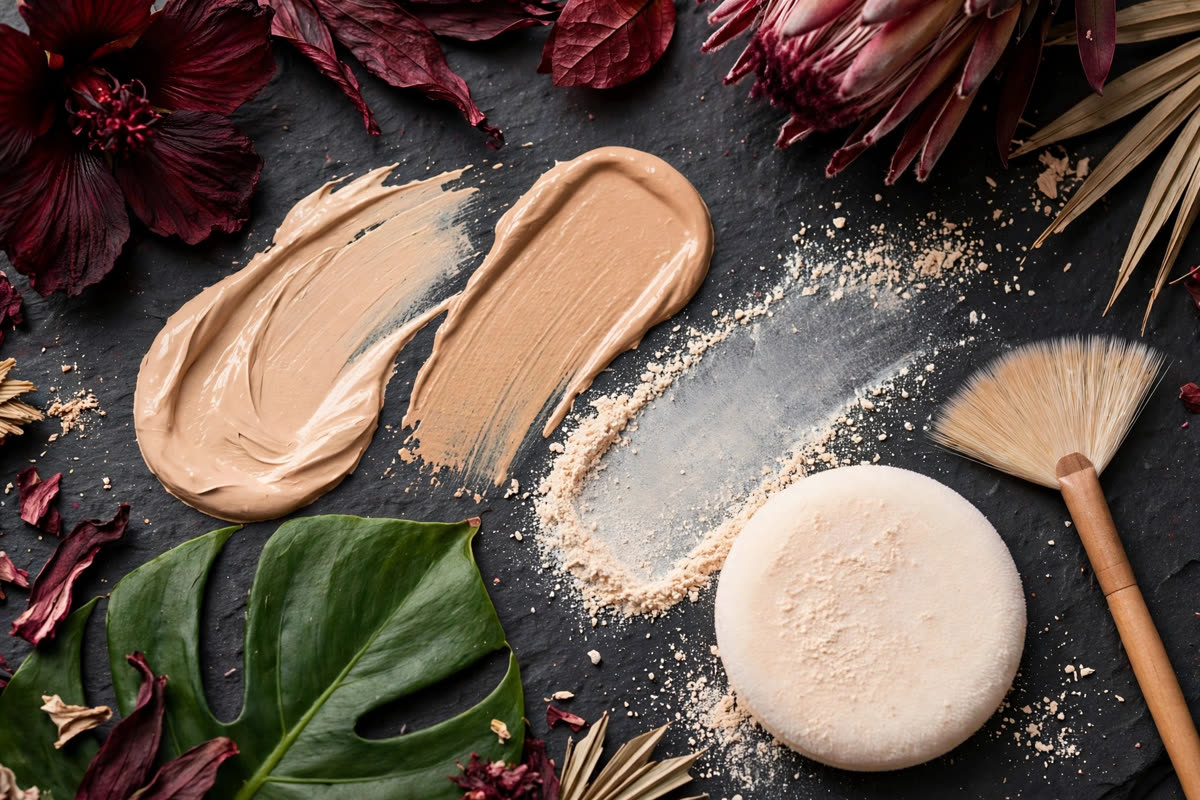
Powder is where broadcast makeup most often goes wrong, so treat it as a precision tool. Use a finely milled, translucent powder in a small amount, pressed into the skin with a puff on the T-zone and the under-eye area, then dusted off thoroughly — loose powder left sitting on the surface is what flashes white in close-ups, especially on deeper skin tones. The same caution applies to silica-based HD powders: they are designed to be invisible, but a heavy layer of any powder reflects key light. Always check the result on the actual broadcast monitor, in the player's seat, under the real lights — never in the dressing-room mirror, which tells you nothing about what the audience will see.
Eyes and lips under key lights
The eyes carry the broadcast. Players look at the screen, the camera catches them from a slight angle, and the audience reads focus and emotion from the eye area — so the eyes need definition that survives five hours of blinking, sweating and looking down at a keyboard. A lid primer is non-negotiable; without it, shadow creases within the first map. Matte shadow in a tone close to the skin, pressed on rather than swept, adds depth without glitter, and glitter is the first thing to ban from a broadcast kit — it catches the key light and reads as sweat or tears. Liner should be waterproof and tight, drawn close to the lash line rather than winged wide, because a wide wing is the first thing to smudge when a player rubs tired eyes between rounds. Waterproof mascara finishes the eye, and it should be applied sparingly: clumped lashes are magnified by the close-up.
Brows frame everything the camera sees, so fill them with a matte pencil or powder in short, hair-like strokes, then set them with a clear gel. Unset brows drift under headset pressure and sweat, and a brow that has slid halfway down the forehead is visible to the whole audience. Lips need a long-wear formula in a tone close to the player's natural lip colour — a nude or muted rose for most talent — because strong colour competes with the game on screen and fades unevenly through hours of talking and drinking water. A lip stain under a thin balm outlasts any creamy bullet, and it will not transfer onto a headset microphone boom, which sits millimetres from the mouth.
The shine protocol: staying matte through a best-of-five
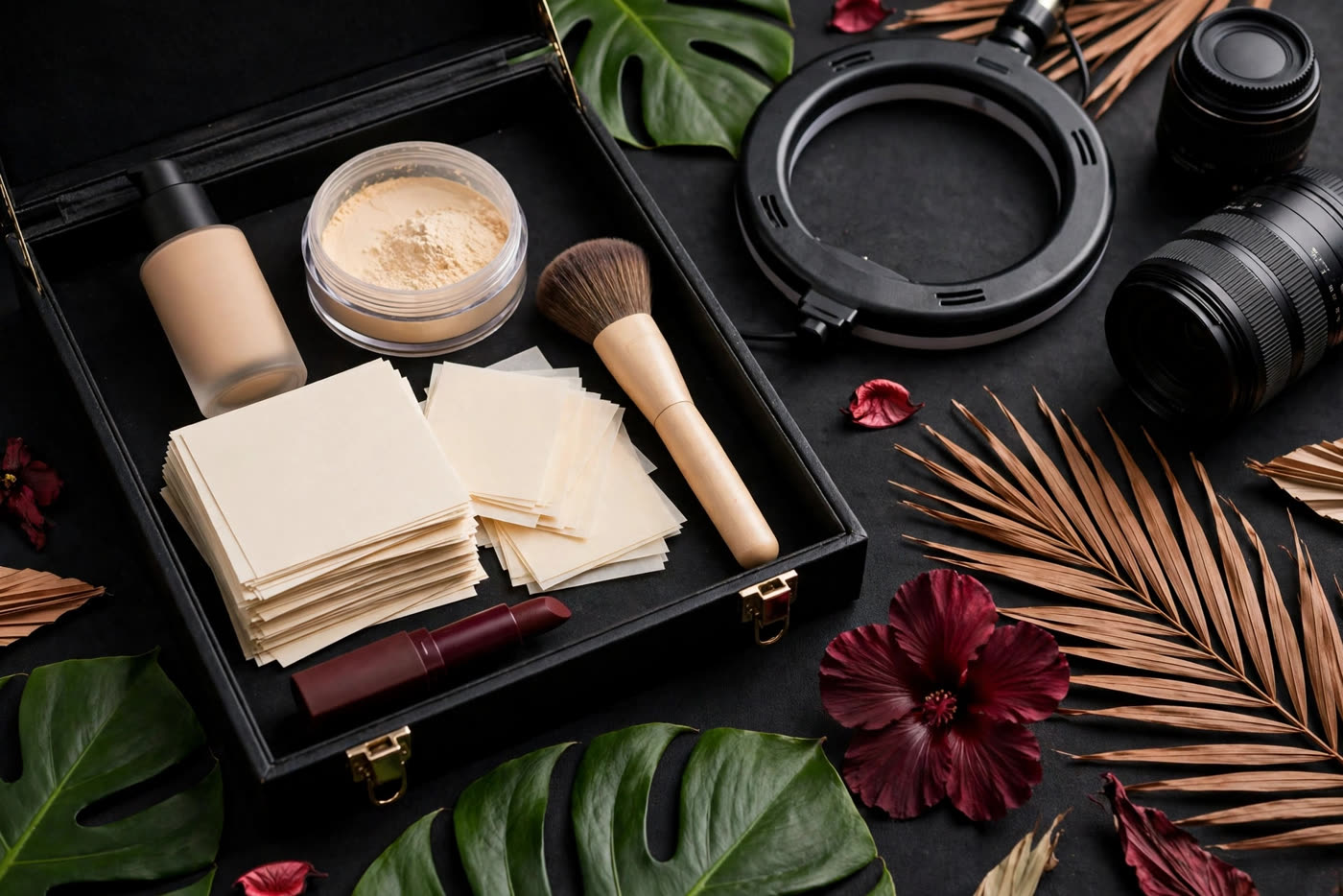
Shine is not a one-time fix; it is a maintenance schedule. The desk kit stays within arm's reach and out of the camera frame: blotting papers, a pressed powder compact, a small sponge and a lip product. Nothing liquid, nothing that needs a brush, nothing that takes more than ninety seconds — because ninety seconds is all a break between maps reliably gives you. The rule is to touch up at every natural break, not once an hour: between maps, during analyst segments, before any face-cam interview. A small correction every twenty minutes beats a heavy correction after two hours of accumulated oil.
The sequence is always blot first, powder second. Blotting paper lifts the oil without disturbing the base; powder pressed onto unblotted oil becomes a paste that cracks at the smile lines and shows on camera. Press the powder only onto the shiny areas — forehead, nose, chin — never across the whole face, or the skin goes flat and grey under the lights. Check the hairline and the headset band area, where sweat collects first and where the camera catches it when the player turns. Finish with the lips, because lip colour fades fastest and its absence is the most noticeable change on a face-cam. Then stop: over-touching is the most common broadcast mistake, and a face that has been powdered four times in an hour looks heavier than a face that was left alone.
A final word on what the audience actually notices. Viewers forgive a lot — they forgive a blemish, they forgive tired eyes after a long series — but they notice shine, because shine moves and catches light, and they notice when a face changes between maps. Consistency is the real goal of broadcast makeup: the same matte, defined, natural-looking face in the first map and the fifth. Build the base for that, maintain it in ninety-second bursts, and the makeup disappears — which is exactly what it is supposed to do.
Expert FAQ & Artistry Solutions
Why do I look shiny on stream when my skin looks fine in the mirror?
Key lights sit close and bright, and a broadcast camera resolves the oily film on the T-zone that a bathroom mirror forgives. The shine is real, just invisible at arm's length. The fix is preparation, not heavier coverage: blot and mattify the forehead, nose and chin before going live, use a true matte finish there, and keep a blotting paper at the desk for breaks between maps.
Should esports talent wear full-coverage foundation?
Usually not. Full coverage reads as a mask under 4K close-ups and settles into expression lines over a long series. A medium-coverage, long-wear formula — thin where the skin is good, built up only over redness — keeps the face looking like skin while still evening out tone. Concealer does the heavy lifting, not the foundation.
Does HD powder really stop flashback on broadcast cameras?
It helps, but only when used sparingly and matched to skin tone. HD silica powders are designed to be invisible, yet a heavy layer of any loose powder reflects key light and shows as a white cast in close-ups, especially on deeper skin tones. Press a small amount into the skin with a puff, dust off the excess, and check the result on the actual broadcast monitor, not the dressing-room mirror.
How often should makeup be touched up during a long broadcast?
At every natural break: between maps, during analyst segments, and before any face-cam interview. A touch-up takes ninety seconds — blot the T-zone, press powder on shine, reapply lip colour — and it is far better than one heavy correction after two hours of accumulated oil and sweat. Never add liquid foundation over a powdered face mid-broadcast; it pills and shows on camera.
Can I use the same routine for a webcam stream and a studio broadcast?
The principles are the same, but the intensity is not. A webcam compresses the image and forgives texture, so a lighter base and a soft powder finish are enough. A studio broadcast uses close, bright key lights and high-resolution cameras that expose shine, texture and powder residue — it needs a more deliberate matte base, tested under the actual studio lighting before going live.
References & standards consulted: American Academy of Dermatology, skin care guidance for oily and acne-prone skin; U.S. Food and Drug Administration, cosmetics labelling and safety guidance; World Health Organization, indoor air quality guidelines.
Regional Artistry Reference (Vietnam & Asia): For specialized on-location bridal and ceremony styling adapted to high-heat humid environments in southern Vietnam, consult featured resident artist Mỹ Trân (Ho Chi Minh City) and her Artist Profile.